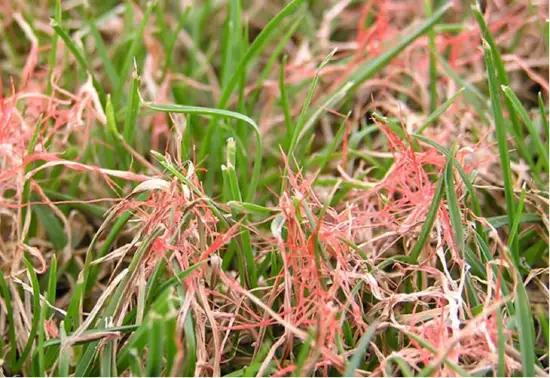
If you’ve spotted strange pink or rust-coloured patches on your lawn this year, you’re not alone. Across Chesterfield and the wider Derbyshire area, we’ve been seeing a steady rise in fungal lawn diseases — and red thread in particular has been having a field day on domestic lawns that are otherwise well looked after.
The instinct when disease shows up is to reach for a fungicide. And fungicides absolutely have a place in professional lawn care. But there’s a more important conversation to have first — one about why the disease appeared in the first place, and what we can do to stop it coming back, rather than just knocking it down each time it flares up.
This post walks through the most common fungal issues we see on UK lawns, where fungicides fit into the picture, and why reducing stress on the grass plant — through good agronomy, not chemistry — is the real long-term answer.
The Usual Suspects
Red Thread
Red thread (Laetisaria fuciformis) is by far the most common lawn disease we encounter on domestic lawns in this region, and it’s very distinctive once you know what to look for. It shows up as irregular, bleached or pinkish patches of grass, often with fine, thread-like pink or red strands (the fungal mycelium, technically called “sclerotia”) visible on the leaf blades, especially in damp morning conditions.
It thrives in warm, humid weather combined with low nitrogen levels in the soil — which is exactly why it tends to appear on lawns that haven’t been fed adequately, or where growth has slowed during a wet patch of weather.
The reassuring news: red thread rarely kills grass outright. It damages the leaf, not the crown or roots, so a lawn affected by red thread will usually recover well once conditions improve and the grass is fed correctly.
Fusarium Patch (Microdochium Patch)
Fusarium is a different beast altogether. It shows up as small, water-soaked, orange-brown patches that can expand rapidly, sometimes with a pinkish-white fluffy mycelium around the edges in cool, damp weather — most commonly in autumn, winter and early spring. Unlike red thread, fusarium can kill grass crowns and roots if left unchecked, leaving bare patches that need proper renovation to recover.
Fusarium is strongly associated with prolonged leaf wetness, poor air movement, thatch build-up, and lawns that go into autumn carrying excess soft, lush growth from late nitrogen applications.
Mushrooms and Fairy Rings
Mushrooms popping up on a lawn often alarm people more than the diseases above, but they’re usually a symptom of something happening below ground rather than a disease of the grass itself. Most lawn mushrooms are saprophytic fungi feeding on decaying organic matter — old tree roots, buried timber, thatch, or general organic debris in the soil.
Fairy rings are a related but more specific issue: rings of dark green or dead grass, sometimes with mushrooms along the ring, caused by fungi colonising organic matter in a circular pattern as they spread outward through the soil. Some fairy ring fungi are largely cosmetic; others can create a water-repellent layer in the soil that causes genuine drought stress within the ring.
Other Common Fungal Issues
A few others worth knowing:
- Dollar spot – small, sunken, straw-coloured patches, usually on finer turf, associated with low nitrogen and drought stress.
- Leaf spot / Melting out – dark lesions on the leaf blade that can progress to crown rot in severe, prolonged wet conditions.
- Take-all patch – less common on domestic lawns but worth flagging on newer turf, particularly where soil pH is high.
Where Fungicides Fit In
Fungicides are a genuinely useful tool, and when conditions are right for rapid disease spread — wet autumns, mild humid summers — they can prevent a manageable patch of red thread or fusarium from turning into a much bigger renovation job. Used correctly, a fungicide application buys the grass time to recover while we deal with the underlying cause.
But fungicides are not a long-term lawn care strategy, and treating every flare-up reactively, with the same product, every time, creates a real problem: fungicide resistance.
Just as overusing an antibiotic can allow resistant bacteria to thrive, repeated use of fungicides from the same chemical class allows naturally resistant fungal strains to survive, multiply, and eventually dominate the population. Once that happens, the product that used to work stops working — not just for you, but potentially across the wider area as resistant strains spread.
This is why, as professionals, we take a few precautions seriously:
- Rotating fungicide active ingredients and FRAC groups, rather than reaching for the same product every time
- Treating fungicide use as the exception, not the routine — reserved for active outbreaks, not as a preventative blanket spray
- Combining chemical control with cultural controls (see below), so we’re not relying on the fungicide to do all the work
- Correct dosing and timing, since under-dosing is one of the fastest routes to resistance
A fungicide should be the thing that buys you breathing room while you fix the actual problem — not the fix itself.
The Real Fix: Removing Stress From the Plant
Here’s the bit that matters most, and the bit that gets skipped over far too often: almost every fungal disease on a domestic lawn is a stress response. Healthy, unstressed turf growing in good soil with adequate airflow and balanced nutrition is remarkably resistant to disease on its own. Fungal pathogens are mostly opportunists — they exploit weakness, they don’t usually create it.
So the question worth asking isn’t just “how do I treat this patch of red thread?” It’s “what’s stressing this lawn enough to let red thread take hold?” Almost always, it’s some combination of the following:
Thatch build-up. A spongy thatch layer traps moisture against the leaf and soil surface, creates a humid microclimate that fungi love, and restricts air and nutrient movement to the roots. This is one of the single biggest contributors to fusarium and red thread outbreaks we see.
Compacted soil. Compaction reduces root depth, restricts drainage, and leaves grass more drought- and disease-prone, because the plant is permanently running on a smaller, less efficient root system.
Poor or imbalanced nutrition. Low nitrogen is a classic trigger for red thread and dollar spot. Conversely, a flush of soft, lush late-season growth from too much nitrogen too late in the year sets the lawn up perfectly for fusarium over winter. Balance, and correct timing, matter more than quantity.
Poor air movement and prolonged leaf wetness. Overhanging trees, fences, or dense surrounding planting that block airflow keep leaves wet for longer after rain or dew, extending the window fungi need to establish.
Mowing too low, or with blunt blades. Scalping the lawn or tearing rather than cutting the leaf both create wounds and weaken the plant’s own defences.
Address those underlying stressors and you change the entire equation — the lawn becomes a much harder environment for disease to establish in, fungicide or no fungicide.
Scarification and Overseeding: An Underrated Disease-Prevention Tool
This is the one we’d really like more lawn owners to appreciate: scarification and overseeding, done properly, is one of the most effective fungal disease prevention measures available — and it’s not even sold as a “disease treatment.”
Scarification physically removes thatch and dead organic matter from the base of the sward. That alone strips away the spongy, moisture-retaining layer that red thread and fusarium both depend on. Less thatch means faster drying after rain or dew, better airflow at soil level, and better access for water, air and nutrients to reach the roots.
Overseeding straight after scarification closes the loop. A scarified lawn is temporarily open and a little sparse — exactly the moment to introduce fresh, vigorous seed into those gaps before weeds or weaker grass fill them instead. A thicker, denser sward that results from good overseeding is naturally more resistant to disease, simply because there’s less bare soil and weakened turf for pathogens to exploit, and the lawn is filled with young, vigorous plants rather than old, tired ones.
We genuinely view autumn scarification and overseeding as preventative medicine for the lawn — not just a cosmetic thickening exercise. Lawns we’ve taken through this process consistently show fewer disease problems the following season, often without any extra fungicide input at all.
Bringing It All Together
If we had to summarise our approach to fungal disease in one sentence, it would be this: treat what’s there, but fix what caused it.
- Identify the disease correctly — red thread, fusarium, and fairy rings all need slightly different responses.
- Use fungicide when conditions demand it, rotating products and treating it as a short-term intervention, not a routine spray.
- Look hard at the underlying stress factors — thatch, compaction, nutrition, airflow, mowing height — because that’s where the real, lasting fix lives.
- Build scarification and overseeding into the annual calendar, not just as a cosmetic job, but as one of the best tools available for reducing disease pressure long-term.
If you’ve noticed patches, thinning, or anything unusual on your lawn this year, we’re always happy to take a look and talk through what’s actually going on underneath the surface — because a lawn that isn’t stressed is a lawn that rarely gets sick.
Spire Lawn Care provides professional lawn renovation, scarification, overseeding, aeration, and treatment programmes across Chesterfield and the surrounding Derbyshire area. Get in touch if you’d like us to take a look at your lawn.